

Day 7: The Reverie
“It couldn’t last forever,
even then we must have known,
But wasn’t it so awfully nice
to not be all alone?”
Today’s Songs
So Awfully Nice
Lex Land, 2020
Que reste-t-il des nos amours?
(I Wish You Love)
Leo Chauliac, Charles Trenet, Albert A. Beach, 1942
It’s been a while…
For a moment, like an old habit, you land in a memory.
It feels different - before, there was bitterness, resentment.
Now, you just feel pangs of tenderness.
You couldn’t be who you’ve become without having gone through this.
A slight smile creeps into the corner of your mouth, and you go about your day...
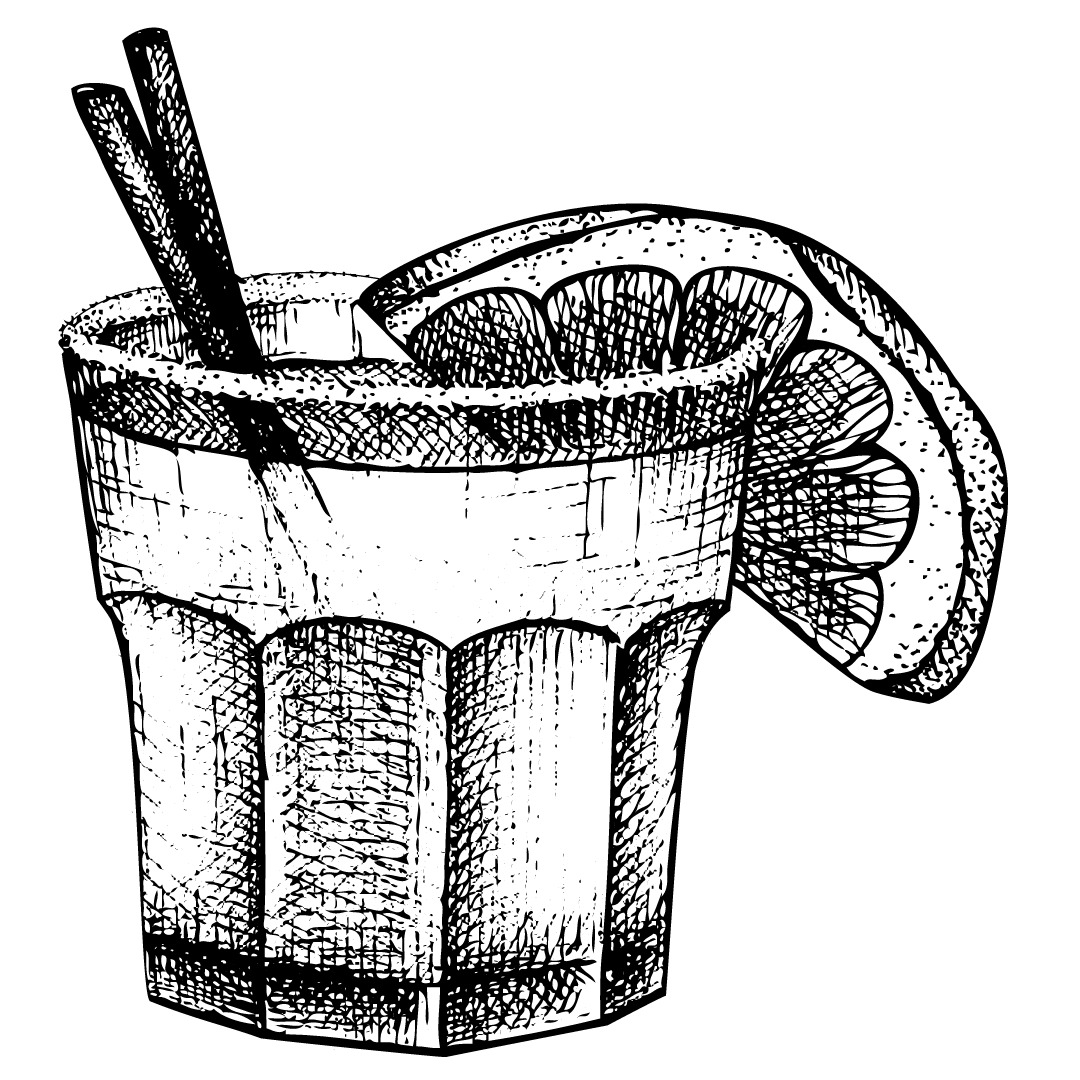
Today’s Cocktail:
Vodka Soda
Reason:
After my “greyhound days” were behind me, vodka-soda became my go-to bar-order.
Equally good for both casual get-togethers as well as the occasional maudlin late-night contemplation, this versatile drink goes down easy and is fun to customize with just about anything you have on hand.
While there’s the suggestion of the drink of the past, there’s a feeling of newness - an empty canvas upon which we are free to paint what we like.
Recipe:
2 oz vodka
soda water to top
couldn’t be simpler: pour your ingredients over ice in your preferred glass. (A shorter one will be stiffer, a taller one leaves more room for add-ins.)
For fun, you can throw in just about any other juice, liqueur, or syrup you’ve got around - for something bright and clean, don’t add anything.
Mocktail variation: pour soda water over ice, garnish with lime wedge. You, too, can add in any syrups or juice you have stocked up if you like.
While you get your drink ready, let Billie remind you of these timeless facts…
…then let Chet Baker swing you into a sweet reverie…
As the album slowly draws to its close, we’re learning how to move forward.
The heartwrenching nostalgia has softened, and now we can appreciate what was without all the bitterness we once felt.
1
So Awfully Nice
It couldn’t last forever,
even then I must have known,
Must have sensed some sort of waning
with each party that was thrown,
But, still, I long for simpler days,
when we had yet to drift apart,
When I still felt that I could trust you with
the deepest reaches of my heart.
O! What a time we had!
What a world we shook-
You, playing the piano,
and me, leaning in its crook...
If all the world’s a stage,
and we all have a role to play,
Then how could I forget my lines
asking you to stay?
Those times seem lacy to me now...
brittle, yet sublime,
A lovely relic rife with holes,
but still a brilliant design.
It couldn’t last forever,
even then we must have known,
But wasn’t it so awfully nice
to not be all alone?
Those times seem lacy to me now...
brittle, yet sublime,
A lovely relic rife with holes,
but still a beautiful design.
It couldn’t last forever,
even then we must have known,
But wasn’t it so awfully nice
to not be all alone?
SONG #1
While yesterday’s I Know It Now might be the strongest original song on the album, So Awfully Nice, is, I think, my favorite.
It’s simple, sappy, sentimental, and resigned. Something about it indicates a slightly more modern pop-feel to its slow-medium-swing tempo and archaic “jazz standard” ABA form. There’s a clarity in the text about what took place in the past, even if there is still a slight whisper of that romance and fantasy that the period bestowed.
If the whole vibe, theme, tone, and feel of the album could be summed up in one song, it would be this one.
So Awfully Nice was the first song I wrote in 2020, a few months before everything shut down. I had recently joined a little peer-to-peer songwriting “club” which distributes prompts weekly, and members are encouraged to turn in a song that includes that prompt before the end of each week.
It was ridiculous for me to think I could actually turn in a weekly song with so much on my plate at the time (though I had spent preceding years of life consistently writing a song per week), but I started the year off strong, at least! The prompt for that week was “play the piano,” so it needed to be included somewhere in the tune.
As is often the case when writing a “weekly” song, at least for me, the expectations and hopes for it being good are not super high. You just kinda do the best you can, and pray it works out.
More often than not, I find that I end up surprised that I wrote something I like. Maybe it’s because of the low pressure, the low expectation, that you allow yourself the freedom to make something “bad” and ultimately get out of your own way enough to make something decent.
This was one of those cases - in starting out, it felt a little flat to me, but the more I worked on it, and the more I performed it afterward, the more and more I liked it. Now I love it- and, as I mentioned, it’s probably my favorite on this collection.
Like all of the songs for this record, this is of course inspired by the tumultuous languishing of a (/"the”) treasured friendship.
Melodically, I reference some favorite standards in this piece: the first line of each "A" is very similar to La vie en rose (1945) and the phrases of the "B" sections allude to Everything Happens to Me (1940), both above.
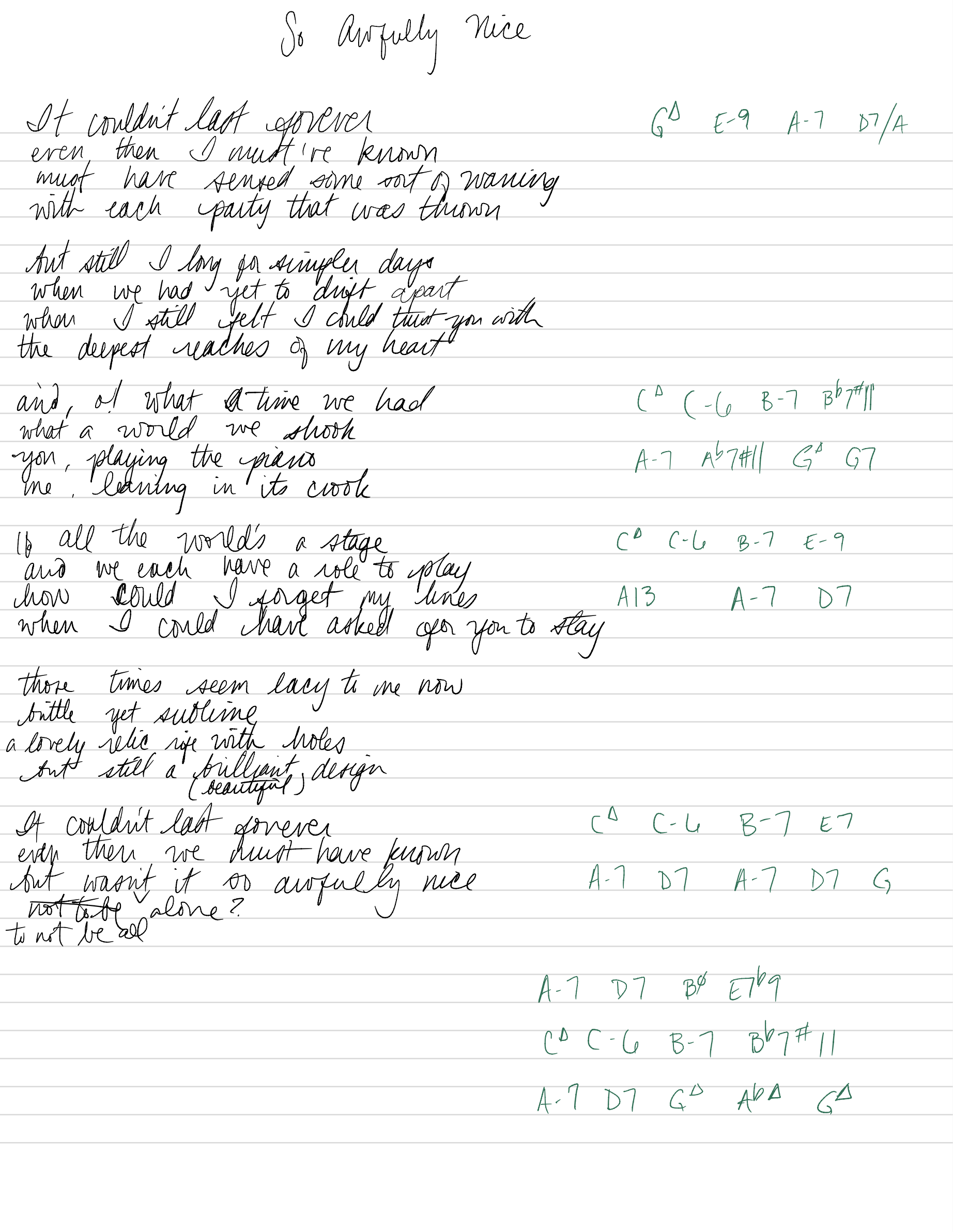
So Awfully Nice
Session Worksheet
2
Que reste-t-il des nos amours?
(I Wish You Love)
Ce soir
le vent qui frappe à ma porte,
me parle des amours mortes,
devant le feu qui s'éteint
Ce soir c'est une chanson d’automne,
dans la maison qui frissonne
et je pense aux jours lointains
Que reste-t-il de nos amours?
Que reste-t-il de ces beaux jours,
une photo, vieille photo de ma jeunesse
Que reste-t-il des billets doux,
des mois d’Avril, des rendez-vous,
un souvenir qui me poursuit sans cesse...
Bonheur fané, cheveux au vent,
baisers volés, rêves mouvants,
Que reste-t-il de tout cela?
Dites-le-moi...
Un petit village, un vieux clocher,
un paysage si bien caché,
et dans un nuage le cher visage
don mon passé
Les mots
les mots tendres qu'on murmure,
les caresses les plus pures,
les serments au fond des bois
Les fleurs qu'on retrouve dans un livre,
dont le parfum vous enivre
se sont envolés... pourquoi?
Goodbye!
No use leading with our chins,
this is where our story ends:
never lovers, ever friends.
Goodbye!
Let our hearts call it a day,
but before you walk away,
I sincerely want to say:
I wish you bluebirds in the spring
to give your heart a song to sing,
and then a kiss, but more than this,
I wish you love,
And in July, a lemonade
to cool you in some leafy glade.
I wish you health, and more than wealth,
I wish you love.
My breaking heart and I agree
that you and I could never be,
So with my best, my very best,
I set you free.
I wish you shelter from the storm,
a cozy fire to keep you warm,
but most of all, when snowflakes fall,
I wish you love.
SONG #2

french entertainer and songwriter, Charles Trenet
Wow… This song is, just, so cool. 🤓
If you’ve listened yet to this song, but perhaps not all the way through to confirm your suspicion, it might sound familiar - as the classic standard I Wish You Love (on my recording, I sing the English version to end it).
I Wish You Love, also included in the genre of “The Great American Songbook,” is another that did not actually originate in America. You can probably tell from the lyrics above, that this song Que reste-t-il des nos amours? is another from the “GAB,” like Autumn Leaves, which was birthed in France.
We have french singer-songwriter Charles Trenet to thank for this song (and many others) that we know and love today.
Though you may not be familiar with much of his work, it is said that his catalogue of original songs numbers close to a thousand!
His lyrics in particular were often unconventional, or even surrealist, especially given the era.
Because this is exemplified in Que reste-t-il… I felt compelled to include a loose (and somewhat interpreted on my part) translation of the french parôles (lyrics) into English below.
Translation of French Lyrics to English:
Tonight the evening wind knocks at my door
And sings to me of dead loves,
Just as the fire goes out.
It's an autumn song,
and in the freezing house,
I think of days gone by...
What remains of our love?
What remains of those beautiful days?
A photo of my youth?
What of the love letters?
The months of April?
The secret meetings?
The memories haunt me endlessly...
Faded happiness,
hair flowing in the wind,
Stolen kisses, stirring dreams...
What remains of it all?
Tell me...
A small village, an old bell tower,
A hidden landscape,
And in the clouds, I see the dear face
From my past.
The tender words we whispered,
The sweet caresses,
the oaths pledged
in the depths of the woods,
The flowers you find now in a book
(the scent of which intoxicates you),
Slipped your grasp -
Why?
What remains of our love?
What remains of those beautiful days?
A photo of my youth?
What of the love letters?
The months of April?
The secret meetings?
The memories haunt me endlessly...
Faded happiness,
hair flowing in the wind,
Stolen kisses, stirring dreams...
What remains of it all?
Tell me...
A small village, an old bell tower,
A hidden landscape,
And in the clouds, I see the dear face
From my past.
I wish I knew the context of this clip, but here you can see a sequence of Charles Trenet in a film while playing his own song on a record.
In my opinion, the lyrics to the french piece are so beautiful, and the songwriting by Trenet as well as his writing partner, Léo Chauliac, is brilliant, too.
In the “verses” (see? we have them again here!), we are painted a picture of the narrator, shivering in an old dark cold house on an autumn night, haunted by the ghosts of his past. In the minor key and with the quick tempo, it brings to mind recollections of Disney’s 1930s dancing skeletons, almost framing the whole song as a ghost story! Of course, I love that.
Walt’s “Silly Symphonies”
The Skeleton Dance (1929)
But then, when the narrator turns to reverie about the warm, lush landscapes and romances of former days, the song turns tender, sweet, and into a major key - with a more relaxed tempo, swung, comfy, cozy.
Something like a romantic “Little Matchstick Girl,” the narrator fades in and out, between a bewitching, welcoming memory of his youthful loves, and the cold, stark reality of finding himself alone on a dark cold night.
[Again, I insert a chef’s kiss here.]
Magnificent and legendary swing-singer Keely Smith (also the wife of Louis Prima at the time), was the first to record the song in English (with lyrics contributed by songwriter Albert Beach).
The story goes that, while going over potential songs to include on her 1957 debut album with the record’s producer, Voyle Gilmore, Gilmore, for fun, played her Que reste-t-til… (just because he liked it and thought it was pretty, not as a potential song for the album).
She was so taken with the song that she insisted it be included: “I’ll do any 11 songs you want, just let me do that one.” It became Smith’s signature song.
Fun fact: the arranger/conductor on this recording is Nelson Riddle, a composer and orchestrator who contributed to the works of most of the huge stars from the Capitol Records golden age, including Nat King Cole, Frank Sinatra, and Ella Fitzgerald.
And since we had Billie get us started, let’s have her send us off with another perfect song for today’s theme…